
If your knife block has one too many mystery blades, you’re not alone.
Most home cooks reach for the same chef’s knife for nearly every task.
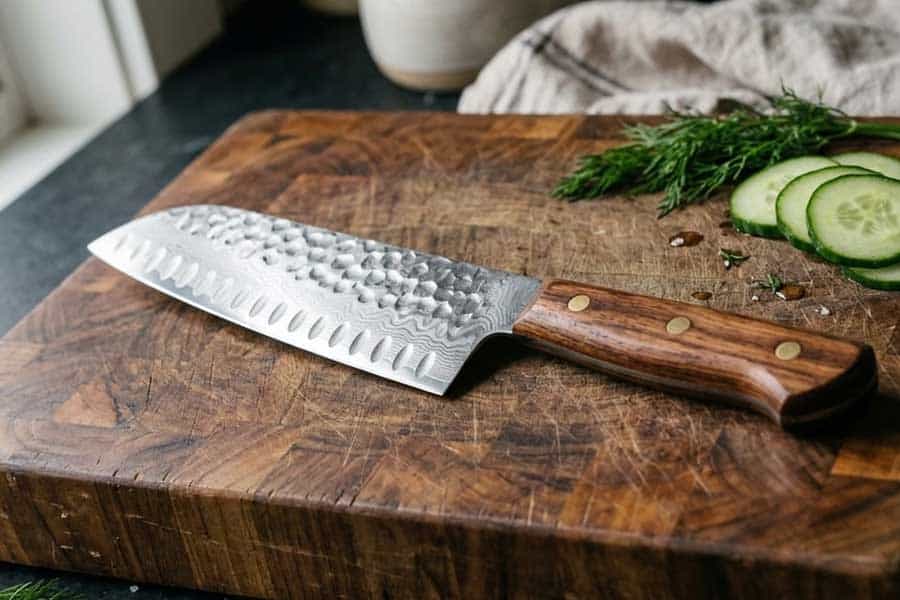
But there’s one knife that deserves a closer look: the santoku.
The santoku knife comes from Japan and has become a favorite in home kitchens around the world.
It’s compact, lightweight, and built for the three jobs you do most: slicing, dicing, and mincing.
In this guide, you’ll find out what a santoku knife is used for, how it differs from a chef’s knife, and how to decide if it’s the right tool for your cooking style.
Key Takeaways
- A santoku knife is a Japanese all-purpose knife made for slicing, dicing, and mincing.
- It works best on vegetables, boneless fish, and boneless meat.
- Its flat blade and shorter length make it ideal for up-and-down chopping, not rocking.
- Most santoku blades are 5 to 7 inches long and lighter than a standard chef’s knife.
- It’s a great choice if you cook with lots of vegetables or want a nimble, easy-to-control blade.
What Does “Santoku” Mean?
The word santoku translates to “three virtues” or “three uses.”
Some cooks say the three virtues are slicing, dicing, and mincing.
Others say they refer to the three foods the knife handles best: meat, fish, and vegetables.
Either way, the name tells you exactly what this knife is about.
It’s not a specialty blade. It’s a general-purpose knife that sits somewhere between a chef’s knife and a vegetable knife.
What a Santoku Knife Looks Like
You can spot a santoku by its shape.
The blade is wide and flat, with a spine that curves down to meet the edge at a rounded, almost blunt tip.
This shape is sometimes called a “sheepsfoot” tip.
Most santoku knives share these traits:
- Blade length: 5 to 7 inches, shorter than most chef’s knives.
- Blade shape: Wide and flat, with little to no curve along the edge.
- Tip: Rounded and low, which makes it safer for fast chopping.
- Weight: Lighter than a Western chef’s knife, usually easier to maneuver.
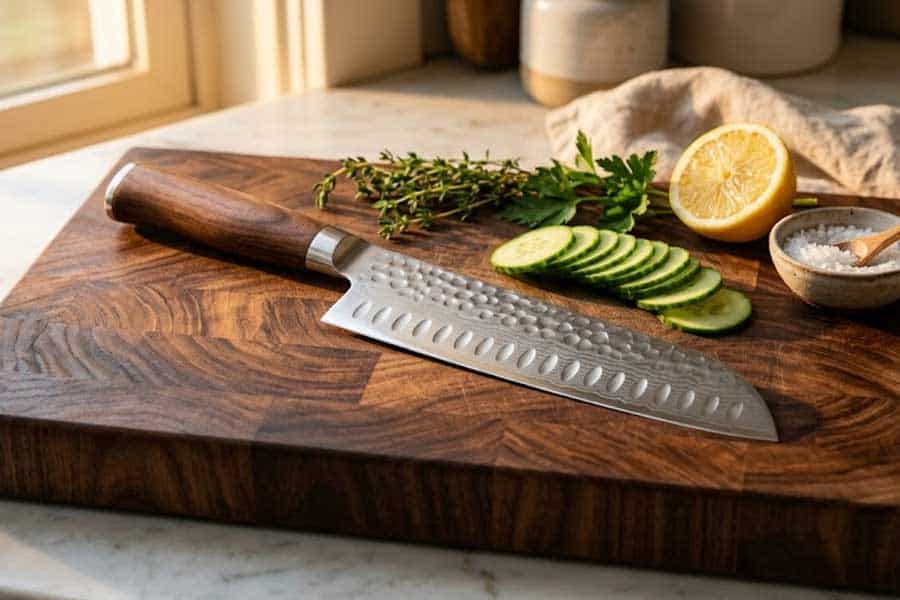
- Granton edge: Some models have small hollow dimples along the blade to help food release.
The flat edge is the most important feature.
It keeps more of the blade in contact with the cutting board, which gives you cleaner, more even cuts.
What a Santoku Knife Is Used For
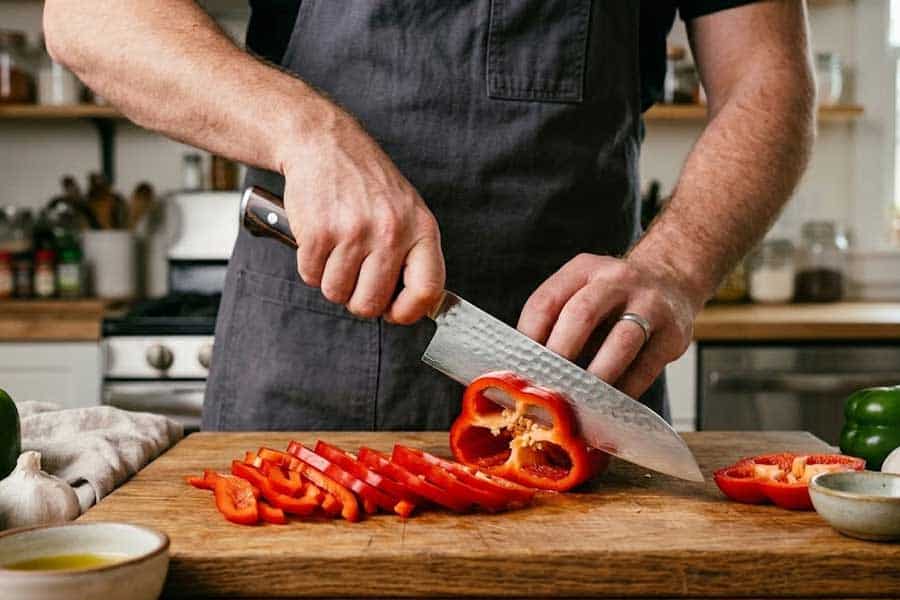
A santoku knife is built for everyday prep.
It’s not meant for bones, frozen food, or hard squash, but it handles just about everything else.
Think of it as a tool for the jobs you repeat most often in the kitchen.
Slicing Vegetables
The flat edge glides through cucumbers, carrots, zucchini, and cabbage.
Because the blade is thin and sharp, it cuts cleanly without crushing the vegetable.
This matters more than you might think.
A crushed tomato or cucumber loses texture and weeps moisture into your salad or onto your board.
Use the full length of the blade for long vegetables like carrots or zucchini.
For round vegetables, slice them in half first to create a flat side.
That keeps them stable and makes your next cuts safer.
Dicing Onions, Garlic, and Herbs
The wide blade gives your knuckles plenty of clearance above the board.
That makes it easy to dice onions, mince garlic, and chop herbs with an up-and-down motion.
You’re less likely to bump your knuckles against the blade than with a narrower knife.
For herbs, bunch the leaves together first.
Then use the tip as a pivot and bring the heel down in a rocking motion.
It’s a small motion, not a full chef’s-knife rock.
For garlic, crush a clove lightly with the flat side of the blade to loosen the skin.
Then trim the root end and mince.
Cutting Boneless Meat and Fish
A santoku excels at slicing boneless chicken breast, pork tenderloin, and raw fish.
It’s the same reason it works well when making salmon crunch roll and you need clean, even slices.
Cut against the grain when you slice cooked meat.
This shortens the muscle fibers and makes each bite more tender.
For raw fish, use long, smooth strokes and let the blade do the work.
Pressing too hard can tear the delicate flesh.
Mincing and Fine Chopping
The rounded tip and light weight make the santoku easy to control for small, precise cuts.
You can mince shallots, ginger, or fresh herbs without switching tools.
For ginger, slice thin rounds first.
Then stack a few rounds and cut them into matchsticks.
Turn the matchsticks and chop across them for a fine mince.
The wide blade gives you room to gather everything back into a pile for a final pass.
Scooping Ingredients
The wide blade can double as a bench scraper.
Use the flat side to scoop chopped vegetables from the board into your pan or bowl.
It’s faster than using your hands and keeps your fingers away from the sharp edge.
Hold the knife with the edge facing away from you.
Slide it under the pile and lift.
You can also use the spine to push loose bits into a neat pile before scooping.
Santoku Knife vs. Chef’s Knife
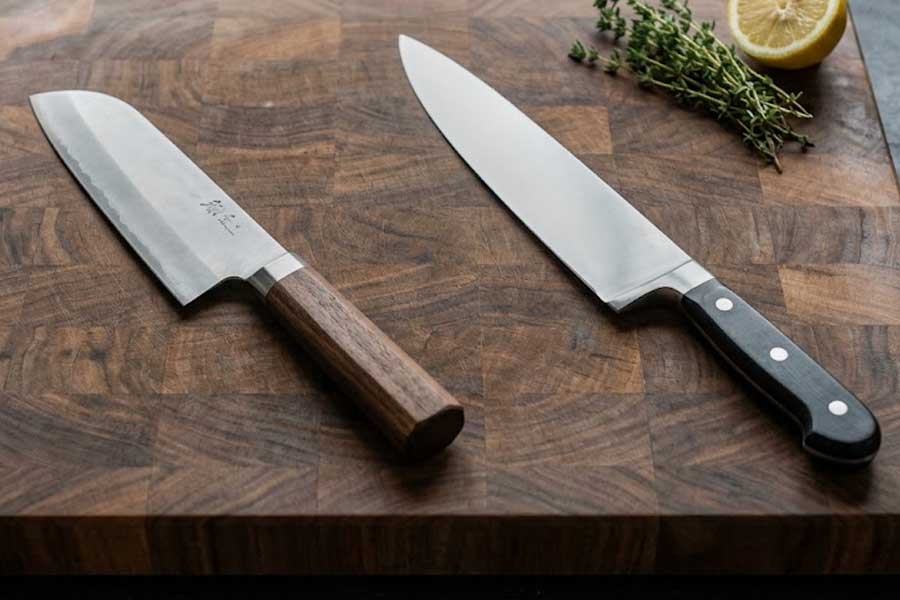
These two knives overlap, but they’re not the same.
The right choice depends on how you cut.
For a full side-by-side comparison, see the guide from LeeKnives.
| Feature | Santoku Knife | Chef’s Knife |
| Blade length | 5–7 inches | 6–12 inches, often 8 inches |
| Blade shape | Wide and flat | Curved along the edge |
| Best motion | Up-and-down chop or push cut | Rocking motion |
| Weight | Lighter | Heavier |
| Tip | Rounded, sheepsfoot | Pointed |
| Best for | Vegetables, boneless fish and meat, fine cuts | Large cuts, herbs, all-purpose Western prep |
If you mostly rock your knife back and forth to mince herbs, a chef’s knife will feel more natural.
If you prefer straight, controlled chops and work with lots of vegetables, a santoku will feel faster and easier.
Many cooks keep both. The chef’s knife handles the heavy work, while the santoku takes care of precision prep.
How to Use a Santoku Knife at Home
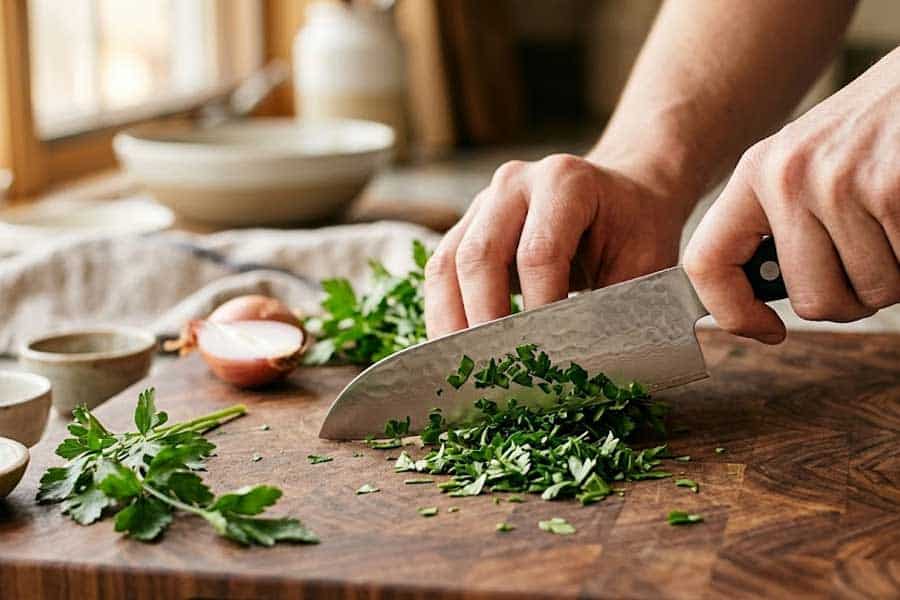
The technique is simple, but it’s different from using a chef’s knife.
Once you get the motion down, your prep work feels faster and cleaner.
Use an Up-and-Down Motion
Place the tip of the blade on the board and lift the handle to make the cut.
Then push straight down.
This is called a push cut or tap chop.
Avoid the rocking motion you’d use with a chef’s knife.
Start slowly until the motion feels natural.
The blade doesn’t need to leave the board.
Keep the tip in contact and use the handle to lift and lower the heel.
This gives you more control and reduces the chance of uneven slices.
Grip the Handle or the Blade
You can hold the handle in a standard grip, or pinch the blade just above the handle with your thumb and forefinger.
The pinch grip gives you more control for precise cuts.
For most home cooks, the handle grip is fine for everyday tasks.
Switch to the pinch grip when you need extra accuracy, like slicing fish thin or making fine dice.
Your other hand should stay in a claw shape, with fingertips tucked under and knuckles guiding the blade.
Let the Knife Do the Work
A sharp santoku should slice through food with little pressure.
If you find yourself pressing down hard, the blade needs sharpening.
Forcing the knife can crush soft foods and increase the risk of slipping.
Use long, smooth strokes for slicing.
For chopping, let the weight of the blade fall through the ingredient.
The santoku is light, so it rewards a gentle, controlled touch.
Use a Stable Cutting Board
A slipping board is one of the most common causes of kitchen cuts.
Place a damp towel under your board to keep it steady.
A board that slides while you chop can send the knife off course.
Use a board large enough for the ingredient.
Crowding a big vegetable on a small board makes the work harder and less safe.
For more guidance on safe food prep surfaces, see the U.S. Department of Agriculture’s cutting board tips.
Caring for Your Santoku Knife
A good santoku will last for years if you treat it well.
The thin blade stays sharp longer than you might expect, but it also needs gentler care than a thick Western knife.
Hand Wash and Dry Right Away
Wash the blade by hand with warm water and mild soap.
Skip the dishwasher.
The heat and jostling can dull the edge and damage the handle.
Dry the blade right away with a clean towel.
This is especially important for high-carbon steel, which can rust if left wet.
Pay attention to the area near the handle where water likes to hide.
Store Safely
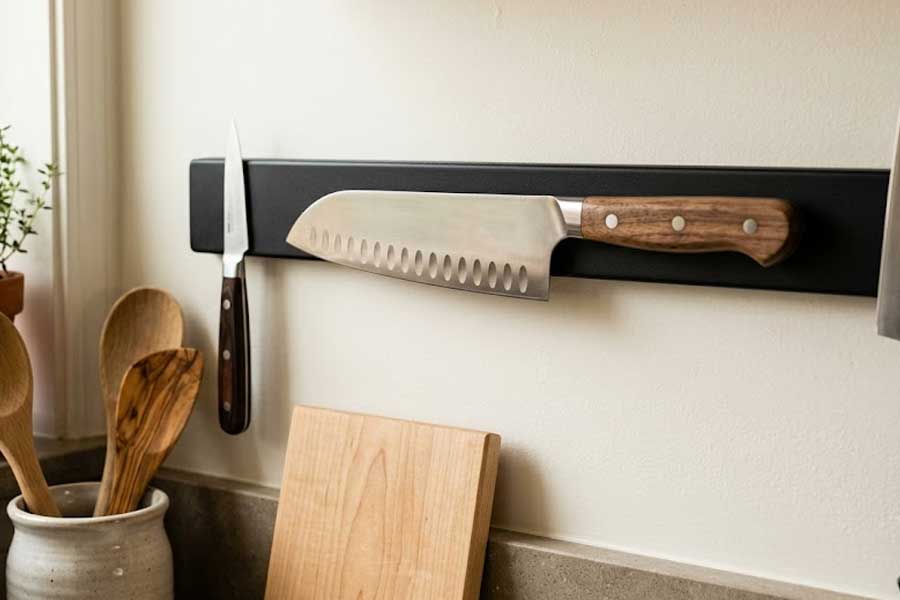
Use a knife block, magnetic strip, or blade guard.
Don’t toss it loose in a drawer.
When blades knock against other metal, they dull and chip.
If you use a magnetic strip, place the spine against the strip first.
Let the magnet catch the blade gently. Never drag the edge across the strip.
Hone Between Sharpenings
A honing steel keeps the edge aligned between sharpenings.
It doesn’t actually sharpen the blade. It just straightens the microscopic teeth that bend with daily use.
Run the blade along the steel at the same angle you’d use for sharpening.
A few light strokes on each side are enough.
Honing once a week is plenty for most home cooks.
Sharpen When the Blade Feels Dull
Use a whetstone or take the knife to a professional when it no longer slices smoothly.
If you sharpen at home, start with a coarse grit and finish with a fine grit.
Match the angle to the manufacturer’s recommendation, usually between 10 and 15 degrees per side.
A dull knife is more dangerous than a sharp one because it requires more force.
You’re more likely to slip and lose control.
Avoid Hard Foods
Don’t cut bones, frozen food, or very hard squash.
These can chip the thin edge.
If a recipe calls for cutting a butternut squash or breaking down a chicken, reach for a heavier chef’s knife or cleaver instead.
A Knife Worth Making Room For
A santoku knife is one of the most useful tools you can add to your kitchen.
It’s light, sharp, and built for the tasks home cooks do every day.
Whether you’re dicing onions, slicing fish for sushi night, or prepping vegetables for a stir-fry, I think you’ll find the santoku makes the work feel easier and more controlled.
It won’t replace every knife you own.
A serrated bread knife and a paring knife still have their place.
But if you want one versatile blade that handles slicing, dicing, and mincing with less effort, a santoku is worth the space in your knife block.
Frequently Asked Questions
Can a Santoku Knife Replace a Chef’s Knife?
For many home cooks, yes.
A santoku can handle about 90% of everyday tasks, including slicing vegetables, dicing aromatics, and cutting boneless meat.
However, a chef’s knife is still better for large ingredients, rocking cuts, and heavy-duty prep.
Is a Santoku Knife Good for Beginners?
Yes.
The shorter, lighter blade is easier to control than a long chef’s knife.
The rounded tip also feels safer for new cooks who are still learning their cutting technique.
Why Does My Santoku Knife Have Dimples?
Those dimples are called a Granton edge.
They create small air pockets between the blade and the food, which helps slices fall away instead of sticking.
It’s especially useful when cutting potatoes, cheese, or thin slices of meat.
Can I Use a Santoku Knife for Bread?
No.
A santoku has a smooth, straight edge that will struggle with crusty bread and may tear the crumb.
For bread, use a serrated bread knife.
How Is a Santoku Knife Different from a Nakiri Knife?
A nakiri is also a Japanese vegetable knife, but it has a tall, rectangular blade with no tip.
It’s designed only for chopping vegetables.
A santoku is more versatile and can handle vegetables, meat, and fish.
Are Santoku Knives Suitable for Left-Handed Cooks?
Most modern santoku knives are double-beveled, which means they’re sharpened on both sides and work equally well for left- and right-handed users.
Some traditional Japanese santoku knives are single-beveled and made for right-handed users, so check the specs before buying.
What Size Santoku Knife Is Best?
For most home cooks, a 7-inch santoku knife is the best all-around choice.
It gives you enough blade length for vegetables and proteins while staying light and easy to control.
If you have smaller hands or a small kitchen, a 5- or 6-inch model can feel more comfortable.
What Should You Not Cut with a Japanese Knife?
Avoid bones, frozen food, hard squash, and thick crusts of bread.
These can chip or roll the thin, sharp edge.
Stick to vegetables, boneless meat, and boneless fish to keep your blade in good shape.
How Do You Sharpen a Santoku Knife?
Use a whetstone at the angle recommended by the manufacturer, usually between 10 and 15 degrees per side.
Soak the stone, run the blade across it in smooth strokes, and work from a coarse grit to a fine grit.
If you’re unsure, a professional sharpening service is a safe choice.
Can You Fillet a Fish with a Santoku?
You can, but it’s not the best tool for the job.
A santoku can slice clean portions from a fillet, but removing skin and bones is easier with a flexible fillet knife.
If you only have a santoku, use a gentle slicing motion and work slowly.
Are Santoku Knives Worth It?
Yes, if you cook with lots of vegetables and prefer a light, precise knife.
A santoku handles most daily prep tasks well and takes up less space than a heavy chef’s knife.
For many home cooks, it’s one of the most useful blades in the kitchen.
LeeKnives
LeeKnives is an OEM and ODM knife manufacturer based in Yangjiang, China, with a history stretching back to 1993.
They partner with global brands and retailers to produce custom kitchen and outdoor knives, from design to finished product.

- Bojangles Coleslaw Recipe - April 19, 2026
- The 12 Best Kombu Substitutes for Your Favorite Recipes - December 8, 2025
- Ruth’s Chris Creamed Corn Recipe - March 8, 2025
