
Before I ever crack an egg or heat a pan, I read the menu.
Not the way you’d read it at a table with a hungry stomach, but slowly, the way you’d read a recipe.
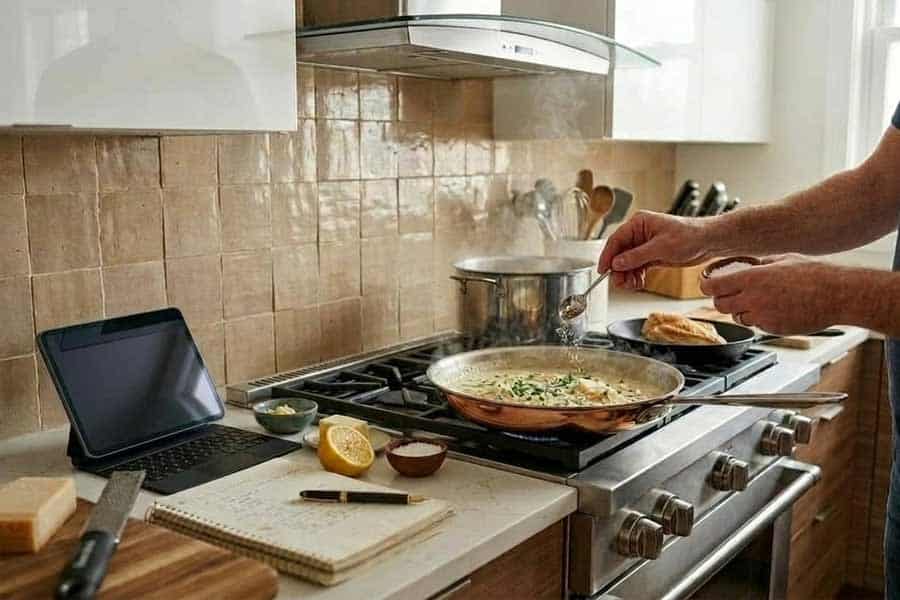
Between the two of us developing copycat recipes for this site, I’d guess we’ve studied a few thousand menu descriptions by now.
That habit is where almost every recipe here begins.
A good menu description isn’t marketing fluff, even when it sounds like it.
This is a condensed set of instructions. After you learn to read it, you will spot the technique in every dish you order.
Why the Menu Is Our First Research Tool
When a reader asks us to recreate a dish, the first thing I do is pull up that restaurant’s current menu online.
I’m looking for the exact wording, the listed sides, the sauces, and anything that hints at how the kitchen actually cooks it.
This has gotten much easier over the last few years.
Most restaurants now publish digital or QR-based menus that stay updated in real time, and many list ingredients and allergen details right alongside each dish.
Platforms like MenuForma are part of that shift, letting restaurants keep prices, descriptions, seasonal items, and allergen info current without reprinting anything.
For a home cook, that’s genuinely useful.
A printed menu from three years ago might list a dish that’s been reworked twice since then.
A live digital menu tells you what the kitchen is sending out tonight.
We’ve caught recipe changes that way more than once, and it saved us from testing an outdated version of a dish.
What Menu Wording Actually Tells You
Restaurants choose their words carefully, and most of those words are technique words.
Here’s how I read the ones that come up most often.
Heat and Cooking Method Clues
Pan-seared means high heat, a dry surface, and a hard crust.
If you see it, your protein needs to be patted completely dry and your pan needs to be hotter than feels comfortable.
Blistered usually points to vegetables cooked fast under very high heat until the skins char and split.
Think shishito peppers or cherry tomatoes, not a gentle sauté.
Charred and flame-grilled tell you smoke is part of the flavor, which is often the piece home cooks miss entirely.
Slow-roasted or braised means time is the main ingredient, and rushing it is the fastest way to get a disappointing copycat.
Fat, Cure, and Preparation Clues
Confit means something was cooked slowly submerged in fat, usually its own.
That’s why restaurant duck tastes the way it does and your oven-roasted version doesn’t.
House-cured tells you salt and time were involved before any cooking happened.
You can’t skip that step and land in the same place.
Compound butter or finished with butter is often the small detail that separates a good home version from an exact match.
I’ve lost count of how many times the missing piece was simply more fat at the end.
Sauce and Acid Clues
Reduction means a liquid was cooked down until it thickened and concentrated.
Emulsion or aioli signals fat and liquid held together, which means technique matters more than ingredients.
Pickled or quick-pickled anything is usually there for acid and balance, and leaving it out will make your version taste flat even if everything else is right.
How We Turn a Description into a Tested Recipe
Reading the menu is step one, and it’s the fast part.
What follows is the part I think people underestimate.
We order the dish, sometimes more than once, and we take notes on texture, seasoning level, and what hits your palate first.
Then we cook it, usually badly, and adjust.
Most of our published recipes here landed somewhere between the fourth and eighth attempt.
A few took longer, and I’ll admit a couple of them nearly beat us.
That’s the honest reason we publish finished recipes instead of guesswork.
You shouldn’t have to burn through eight pounds of chicken to figure out the marinade ratio.
We’ve already done that part.
How You Can Use This Skill Tonight
You don’t need to develop recipes to get value out of reading menus this way.
Next time you’re browsing a restaurant’s online menu, slow down on one dish you love.
Note the cooking method, the fat, the acid, and the finishing touch.
Then check whether your version at home includes all four.
Nine times out of ten, I’ve found the gap is acid or fat, and it’s usually acid.
You’ll also start noticing which dishes are genuinely hard to replicate and which ones are surprisingly simple.
A twelve-hour smoked brisket isn’t a Tuesday project.
A blistered vegetable side with a good compound butter absolutely is.
Read the Menu, Then Come Cook with Us
Menus are the closest thing restaurants give us to a recipe card, and they give away more than most kitchens realize.
Learning to read them will make you a sharper cook even on nights you’re not chasing a copycat.
And when you’d rather skip the testing phase entirely, that’s what our recipe library is for.
We’ve done the reading, the ordering, the failing, and the retesting.
You get the version that finally worked!

- Bojangles Coleslaw Recipe - April 19, 2026
- The 12 Best Kombu Substitutes for Your Favorite Recipes - December 8, 2025
- Ruth’s Chris Creamed Corn Recipe - March 8, 2025
