
Food claims have a shelf life, and it’s usually shorter than anyone expects.
A phrase shows up, it’s genuinely useful for a while, then everyone starts using it and it stops meaning much.
Low fat went through it, and so did clean eating.
Gut health is going through it right now, and the ingredient level trend data shows exactly where cooks are heading instead.
The shift isn’t really about buying different groceries, though, so here’s why it matters for your kitchen.
It’s about knowing which ingredients actually do something on your plate and how to cook with them well.
Your Gut Health Staples Aren’t Going Anywhere
Start with the four ingredients everybody already links to this idea, since they carry the whole conversation: broth, olive oil, apple cider vinegar, and potatoes.
All four have gone flat in the data, with olive oil slipping 1.6% in the past month and lentils now reading as a declining ingredient.
I want to be clear about what that means, because it’s an easy thing to misread.
Flat doesn’t mean bad. Flat means settled.
These four are already in your pantry and already doing good work, so there’s simply nothing new left to say about them.
Apple cider vinegar is the clearest example, tied tightly to the claim and already sitting on nearly every shelf in the country.
That’s a finished conversation rather than a failed one.
So keep making your broth, keep finishing vegetables with good olive oil, and keep whisking vinegar into your dressings.
Those habits still earn their place, and honestly, a jar of homemade stock in the fridge does more for your week of cooking than any trending powder ever will.
The Named Ingredients Cooks Are Actually Chasing
Now here’s where all the movement went instead.
Psyllium grew 43.75% over the year, polyphenols grew 30.53%, and anthocyanins grew 19.65%.
Ashwagandha grew 10.79% and it’s one of the few still climbing month to month, which tells me that growth is recent and still building.
Colostrum belongs in this group too, closely tied to the claim and barely showing up on menus anywhere.
Every one of those is specific, growing, and almost completely absent from restaurant food.
People stopped asking for gut health and started asking for a named fiber, a named compound, or a named effect.
If you’re wondering how any of that translates to actual dinner, here’s the short version.
Psyllium
This one is a fiber husk, and it works as a genuinely useful binder in your kitchen.
A teaspoon or two thickens soups and stews without any flour, and it’s also the reason so many gluten free breads hold together instead of crumbling.
Start small, because it absorbs a surprising amount of liquid.
Polyphenols
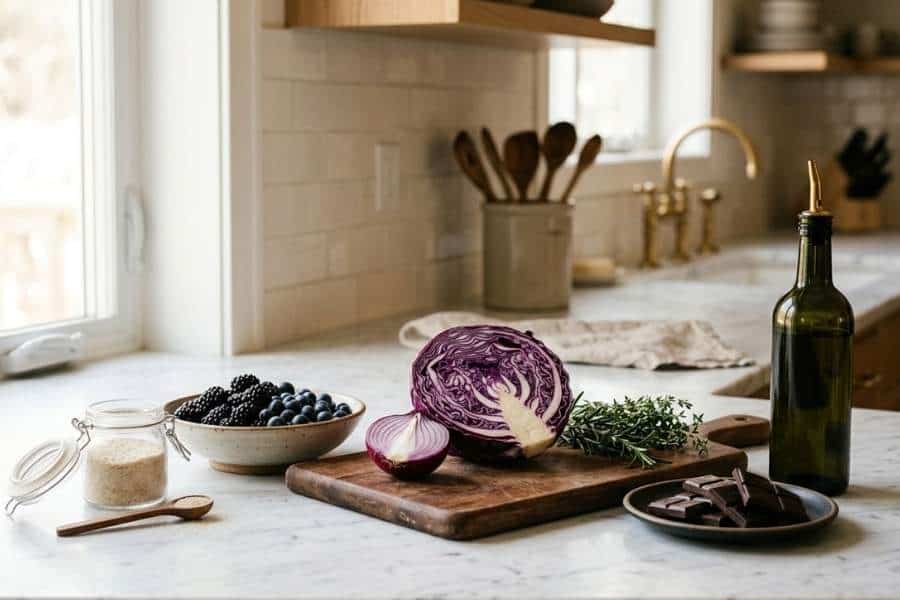
You’re already cooking with these constantly, since they’re in your extra virgin olive oil, dark chocolate, coffee, green tea, fresh herbs, and red onions.
That slight peppery catch at the back of your throat from a fresh olive oil is literally polyphenols announcing themselves.
Anthocyanins
These are the pigments behind deep purple and red produce like blackberries, blueberries, red cabbage, purple sweet potatoes, and black rice.
Here’s a cook’s note I love, since they’re pH sensitive: add a splash of vinegar or lemon to red cabbage and it turns brilliantly pink instead of dull blue.
Ashwagandha and Colostrum
These two live mostly in powder form, so they tend to end up in smoothies, lattes, and morning drinks.
Ashwagandha is earthy and a little bitter, which means it needs something to hide behind like cocoa, banana, or dates.
Colostrum is much milder and mixes into cold liquids far better than hot ones.
What This Means when You’re Shopping and Cooking
Three things follow from all of this, and I think they’re worth separating out.
First, the wording on a package ages a lot faster than the food inside it does.
The yogurt you bought for gut health in 2024 is almost certainly still the right yogurt, and only the front of the tub has changed.
Don’t let a dated label talk you out of an ingredient that’s already been working for you.
Second, specific claims come with a burden that the vague ones never carried.
The moment a package names psyllium or a polyphenol, you can reasonably ask how much is in there and what it’s supposed to do.
That’s great news for you as a shopper, and fairly uncomfortable for any brand that’s been coasting on a fuzzy phrase.
Third, these named ingredients are still uncrowded, since all of them barely register on restaurant menus, which means you’re early while everyone else sits on the general claim.
Home Cooks Are Finding These First
There’s one pattern here that’s easy to miss, and it happens to be my favorite part.
These specific ingredients have very low menu presence while people talk about them constantly, which means the cooking is happening at home first.
That’s usually how it goes, and the reason is pretty simple.
You can test a spoonful of psyllium in one loaf of bread on a Sunday, while a restaurant can’t gamble a whole service on it.
Home kitchens experiment at a scale professional ones can’t really afford, so grocery shelves see the shift long before menus ever do.
If you read labels, that gap between the two is the genuinely useful part.
Whatever people are cooking with now is what shows up on shelves next.
How to Spot the Next Shift in Your Own Kitchen
You can run this check yourself, and it only takes about an afternoon.
Write down the ingredients you personally associate with whatever claim you tend to cook by.
Sort out which ones truly belong to that claim and which are just common in every kitchen.
Then ask yourself which ones you’re hearing more about lately and which have gone quiet.
If your staples are steady while the named ingredients keep climbing, the claim is breaking apart into its pieces.
Follow the specific ingredient, which is what the cooks around you have already started doing, though they’ve just found better words for it.
The figures here come from Tastewise and describe the US market as of September 2026.
FAQs
Should I stop buying olive oil and apple cider vinegar?
Not at all, because flat trend data just means they’re already established in kitchens everywhere.
They’re still two of the most useful things sitting on your counter.
How much psyllium should I add to a recipe?
Begin with a teaspoon per batch and see how much it thickens things.
It swells fast, so only add more after your mixture has rested a few minutes.
What’s the easiest way to get more polyphenols into my cooking?
Finish your dishes with a good raw extra virgin olive oil instead of cooking it away.
Leaning on fresh herbs, red onion, and dark chocolate helps too.
Do anthocyanins survive cooking?
They hold up reasonably well, though they do leach out into cooking water.
Roast or quickly sauté your purple produce rather than boiling it.

- Bojangles Coleslaw Recipe - April 19, 2026
- The 12 Best Kombu Substitutes for Your Favorite Recipes - December 8, 2025
- Ruth’s Chris Creamed Corn Recipe - March 8, 2025
