
You pay good money for a delicious takeout feast or spend hours cooking a beautiful Sunday dinner.
But fast forward to the next day, and those glorious leftovers often meet a tragic fate in your microwave.
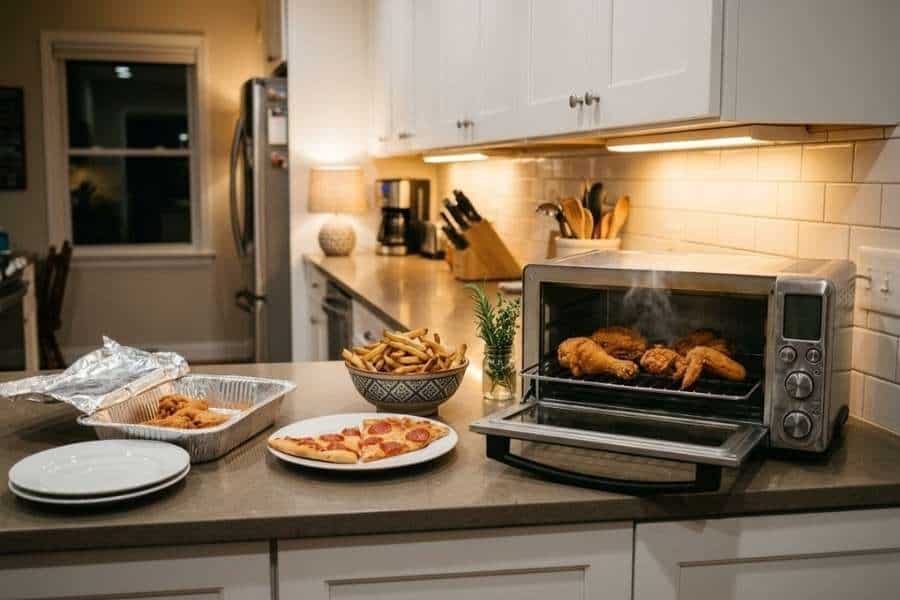
Suddenly, your crispy fries are rubbery, your pizza crust tastes like damp cardboard, and that expensive steak has curled into shoe leather.
Reheating leftovers properly is honestly one of the easiest ways to stretch your grocery budget, get more value out of your meals, and cut down on unnecessary food waste.
But if you want yesterday’s dinner to actually taste good today, you can’t just press the “+30 Seconds” button and hope for the best.
Different foods need completely different heating methods.
Here’s exactly how I bring my favorite comfort foods back to life so they taste just as incredible on day two.
How to Reheat Fried Foods and Keep Them Crispy
When you stash leftover fried chicken, mozzarella sticks, or those tricky french fries in the fridge, the moisture from the inside of the food slowly creeps outward into the breading.
That’s why fried foods get notoriously soggy overnight.
To fix this, you need dry heat that can quickly evaporate that surface moisture without turning the inside into dust.
For anything breaded or fried, your most reliable tool is an air fryer.
Because it relies on rapid, high-speed air circulation, it actively pulls moisture away from the crust, crisping up the exterior beautifully without needing a fresh batch of oil.
For most small fried snacks, you’ll want to set your temperature around 350°F (175°C).
Check on them after 3 to 5 minutes.
The exact time will depend heavily on the thickness of your food and how cold it is right out of the fridge.
Give the basket a good shake halfway through so nothing sticks, and you’ll find that much of that original, satisfying crunch comes right back.
How to Reheat Pizza and Other Large Portions
Basket-style fryers are brilliant for a handful of fries, but they definitely have spatial limits.
Try cramming a massive slice of New York-style pizza or a wide portion of a casserole into a compact basket, and you’ll end up with folded food that steams rather than crisps.
Overcrowding is the quickest way to ruin a reheating job.
When you’re reheating larger portions, a countertop oven can give you more usable surface area than a compact basket-style appliance.
A COSORI air fryer toaster oven can be particularly convenient for laying pizza slices flat while reheating them evenly.
For a few slices of pizza or smaller oven-safe baking dishes, I find a countertop oven far more practical than waiting 15 minutes for your heavy-duty kitchen oven to preheat.
The flat rack lets the ambient heat melt the cheese on top at the exact same rate that the bottom crust crisps up, giving you a perfect slice in just a few minutes.
When the Stovetop Works Best for Soups, Stews, and Pasta
Keep your liquid-heavy dishes far away from the oven.
If you’re trying to rescue a batch of leftover chili, a creamy chowder, or yesterday’s penne alla vodka, the stovetop is where you want to be.
Here’s the thing about pasta and stews: they act like sponges in your refrigerator.
A dish that was perfectly saucy last night will often turn into a solid, congealed block by morning.
To fix this, transfer your leftovers into a saucepan over medium-low heat.
The essential trick here is hydration.
Add a splash of water, a spoonful of chicken broth, or a tiny bit of milk if you’re dealing with a cream-based sauce.
This extra liquid replaces the moisture that the starches soaked up overnight.
Stir your pot often to keep the bottom from catching and burning, and let it warm up slowly until it reaches a gentle simmer.
How to Reheat Meat without Drying It Out
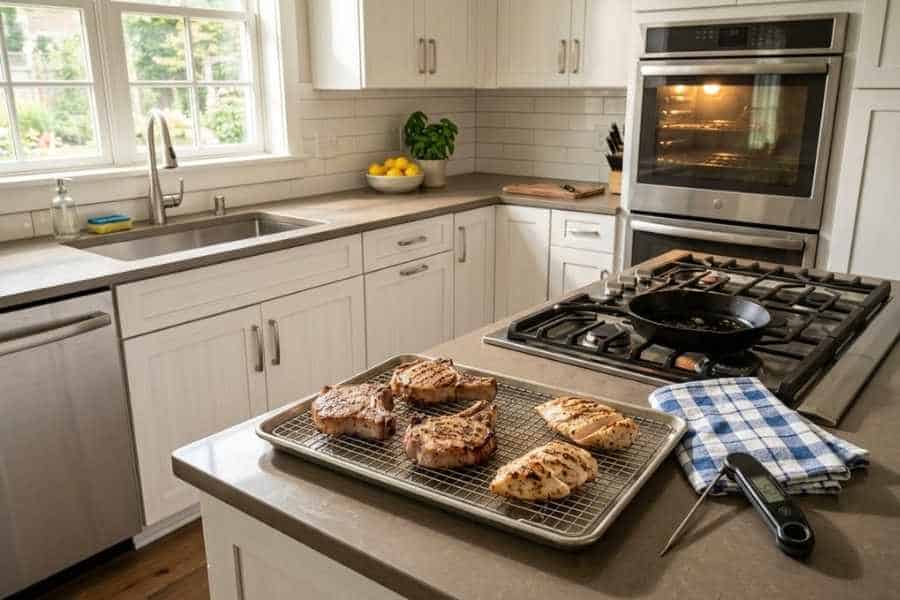
Reheating a thick pork chop, a chicken breast, or a nice cut of steak can feel pretty intimidating.
Meat is incredibly unforgiving, and blasting it with heat will instantly squeeze out the natural juices, leaving you with a tough, dry dinner.
Patience is your best ingredient when you’re dealing with dense proteins.
The best method I’ve found is to place your meat on a wire rack set over a standard baking sheet.
Slide this into your regular oven at a very low temperature, somewhere around 250°F (120°C).
This gentle, ambient heat warms your meat slowly from the outside in.
By taking your time, you avoid shocking the muscle fibers.
Once the meat is warmed all the way through, you can take it out and give it a lightning-fast sear in a hot, lightly oiled skillet, just about one minute on each side.
That brings back the savory crust on the outside while keeping the center perfectly tender.
When the Microwave Still Makes Sense
Despite its reputation for ruining pizza, your microwave isn’t the enemy.
It’s undeniably terrible at keeping a crisp texture, but it’s incredibly convenient and absolutely the right tool for certain leftovers.
Microwaves work by interacting with water molecules to generate heat, which naturally creates steam.
Steam destroys a crispy chicken wing, but it’s genuinely great for foods that are supposed to be soft and moist.
Rice, steamed vegetables, soft noodles, and broths all reheat beautifully in your microwave.
To get the best results, try the damp paper towel trick I swear by.
Drape a lightly moistened paper towel over your bowl of rice or noodles before microwaving, and that traps the steam and rehydrates the grains.
Also, don’t be afraid to lower your microwave’s power level to 50% or 70%.
Heating your food a little slower keeps the edges from turning into hard rubber while the center stays ice cold.
How to Reheat Leftovers Safely
Taste and texture matter, but we can’t talk about leftovers without touching on basic kitchen safety.
Handling your food properly keeps harmful bacteria from ruining your week.
First, always practice the “two-hour rule.”
Don’t leave your takeout or home-cooked meals sitting on the counter for hours.
Get them into airtight containers and into your fridge promptly.
When it’s time to eat, you need to make sure your food is heated all the way through.
For dense items, especially leftover meats or casseroles with poultry, grab a food thermometer.
You’re aiming for a safe internal temperature of 165°F (74°C).
Never go by how hot the outside of the bowl feels or whether the sauce is bubbling at the edges, since the center of your dish can still be dangerously cold.
Making Day-Two Meals Worth Looking Forward To
Conscious eating goes hand in hand with smart kitchen habits.
You don’t have to settle for sad, soggy day-two meals.
By taking just a few extra minutes to pick the right reheating method, whether you’re leaning on the dry heat of a countertop oven, simmering gently on your stove, or using your microwave strategically, you can turn yesterday’s dinner into today’s treat.
I’d rather spend five thoughtful minutes reheating a good meal than throw it out, and your grocery bill will thank you for it.

- Bojangles Coleslaw Recipe - April 19, 2026
- The 12 Best Kombu Substitutes for Your Favorite Recipes - December 8, 2025
- Ruth’s Chris Creamed Corn Recipe - March 8, 2025
